

In society we often don’t think of accessibility until we are in a situation where our needs aren’t being met. For some, accessibility is an everyday challenge because we often don’t design for the needs of all people. Designing for accessibility might be simple things like not having signage that is clear and concise, in large print, and in easily seen locations. Statistics Canada’s 2017-2022 Report found that 27% of the population 15 or older have a least one disability, which is a significant amount of our population. During this time there was almost a 5% increase in the disabled population, which sparked discussion about addressing accessibility in Canada. In 2019 the Government of Canada put out the Accessible Canada Act, which aims to create equal protection and benefits for those who live with disabilities. Statistics Canada has also created a Road to Accessibility, which is a plan to create a barrier free Canada by the year 2040 by actively tracking changes in barriers to see if accessibility is improving. The Accessibility Canada website provides a lot of great resources, such as online courses and training. They also have courses for larger groups such as businesses and university programs.
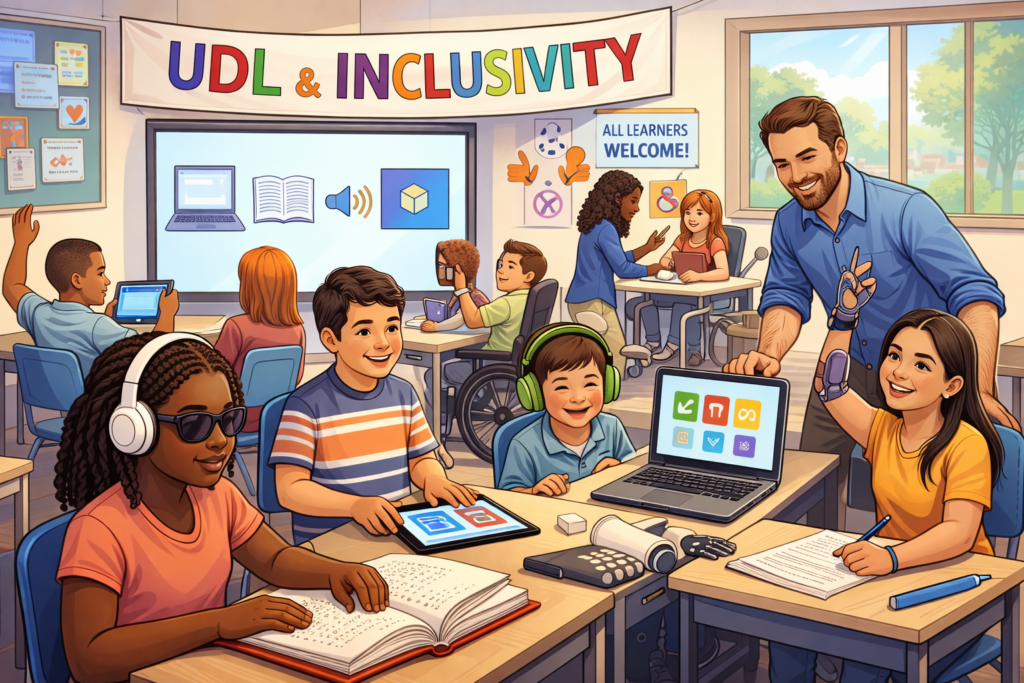
Accessibility starts by recognizing that all people, regardless of their ability, bring in unique and individual perspectives that are valuable to our larger society. We also need to recognize that disability is a blanket term, but abilities exist in a spectrum. For example, when we say someone is blind that doesn’t necessarily mean they can’t see anything, but they could be severely visually impaired and only able to see shapes in bright lighting. Accessibility won’t be the same for any two people even if they have the same disability. To begin overcoming this complexity, we use Universal Designs, which means creating products, environments and services that can be used by all people.
Universal Design for Learning (UDL) is a framework that removes barriers by first considering what approaches need to be taken to support people who have the greatest needs. In other words, we should design using accessible and inclusive approaches that support marginalized populations, including disabled or marginalized people. When we look to technology to create supports, this includes simple technology as well like ramps for wheel chair users. We also can use more complex technologies such as as text-to-speech readers for those who are visually impaired.
Carleton University is using Virtual Reality (VR) and Augmented Reality (AR) to create interactive learning experiences. I personally really like the idea of VR for engaging students interests and allowing non-visual learners to have manipulatable models. I also see the potential for allowing students with mobility issues to go places they otherwise wouldn’t be able to go. However, I wouldn’t choose this over creating an experience that students with mobility issues were able to participate in. I think a large part of accessibility is pushing for change and creating an inclusive environment that normalizes having all abilities. Field trips are such a exciting part of elementary experiences so leaving them out of that would feel wrong.