
Integration models are are frameworks that guide educators to integrating technology into their classroom. Some models are teacher focused and describes how can be successful as educators. Other models are student focused allowing for increased engagement and agency. I wanted to focus on how we can provide students with supports but build their independence and teach self-management. Giving students technological tools doesn’t always have to be complicated. It might be something simple like showing a video in your classroom or using an app to do a mindfulness activity. By doing simple things with technology you are still modelling the use of technology. This is especially important for younger students who need to see how we can use technology to our benefit for learning. As children get older and they are able to take on more responsibility and use devices for simple tasks you can begin to design learning with technology as a functional part of learning. Eventually, students will be able to explore and learn with devices on their own because you have established self-management skills while using technology. Models that supports this methodology are the SAMR Model and the TIM Model.

Substitution, Augmentation, Modification and Redefinition (SAMR) Model is a scaffolded model that builds students competence with technology. This model supports teachers by providing a gradual release of responsibility to students. This scaffolding allows for teachers to select the best devices and services that will be compatible with what students have learned so far and are capable of doing. The different levels include substitution, augmentation, modification, and redefinition. Substitution is the most teacher dependent and is a replacement of something that can be done without technology to something with technology. Augmentation creates a change in the function of the task by embedding technology. Modification redesigns the task to have more significant use of technology. Redefinition places more responsibility on the student and allows students to engage in a task that would not be possible without technology. Lets consider what the different scaffolded levels might look like in a class. For substitution, a teacher might show a video to a class then fill out a worksheet. Augmentation of the task might be having students watch a video on the site and fill out a online questionnaire. Modification might get students to explore a webpage with videos and gamified questions to build and check their understanding. Redefinition might get the students to explore a webpage, create a short slide deck on their key takeaways, and share with a partner.
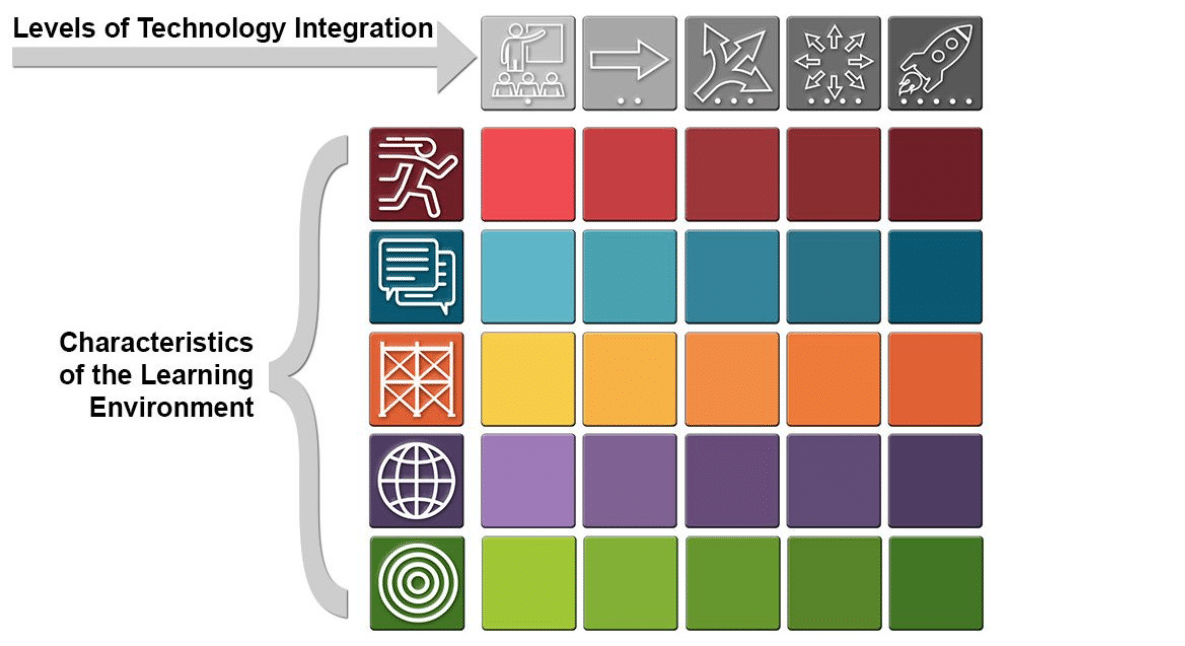
Technological Integration Matrix (TIM) Model looks at five levels of technological integration (entry, adoption, infusion, and transformation) with five characteristics of meaningful learning environments (active, collaborative, constructive, authentic, and goal-directed). The focus is on pedagogy and gives teachers specific procedures and roles, allowing for them to guide student learning with more ease. This model provides a gradual release of responsibility from teachers to students. It provides a lot of supports embedded within their website making it a great resource for teachers who have little experience with using technology in a class. This tool develops confidence for both teachers and students and allows them to grow together by exploring different levels of technological integration. When clicking any area within the matrix, you are taken to a page that gives you a more detailed description and provides you with video lesson examples.
Other integration models include for teachers to explore:
- The Technology, Pedagogy, and Content Knowledge (TPACK) Model allows you to create content and redesign by using your pedagogical and content knowledge. The different domains are in constant tension and only through practice can you align these methods.
- Community of Inquiry (COI) is a framework that focuses on three core elements: social, cognitive, and teaching presence. This model uses blended learning to give experiences more meaning by engaging students with content, other participants, and creating goals. This approach focuses on student-led learning and uses teachers to oversee operations and help direct students to their goals.